*10 Talking Points on the SS Lesson 2:*
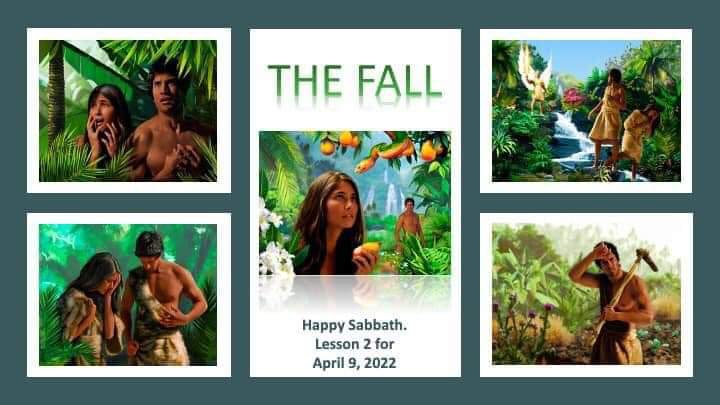
*THE FALL*
*1.* Last week’s lesson demonstrated God’s plan that allows His creation to manifest new forms as population grew. Creation and recreation are therefore part of what we experience in our world. This week we study ‘The Fall’: when sin and death entered our world. Yet by becoming the new creation of God through the recreating power of God’s word, Jesus, our destiny is to be eternal life.
*2.* Humans were created by God, in His image, without sin. The word ‘fall’ describes the change of humans from being ‘without sin’ to being ‘with sin’. This fall emanated from ‘eating the fruit of the tree of knowledge of good and evil’. Why did God create this tree? How different was this tree from the tree of life both of which were planted at the centre of the garden of Eden (Gen 2 v.8-9)?
*3.* The instruction from God was that if Adam and Eve were to eat of the tree of knowledge of good and evil, they would surely die (Gen 2 v.15-17). Satan, through the serpent, misrepresented God’s word to Eve and deceived her (Gen 3 v.1). The serpent was described as the most cunning animal. If the serpent was not a useful tool in the hands of Satan and man did not sin, would these attributes still be appropriate in a sinless world?
*4.* The serpent told Eve that when you eat of the tree of knowledge of good and evil, they will not surely die (Gen 3 v.4) and shall be like God, knowing good and evil (Gen 3 v.5). Did Eve die immediately after eating the fruit? How do we reconcile this with the fact that God had said ‘you shall surely die’ when you eat the tree? Why did Adam accept Eve’s suggestion to eat the fruit?
*5.* When both Adam and Eve had eaten the tree, for the first time they experienced shame and guilt as they lost God’s righteousness. Could this be synonymous with the fact that they then knew good and evil, when previously they knew good only? Why did they desire to know evil if they already knew good? Why is it easy to throw Godly caution away for something new?
*6.* After the Fall, the couple ‘created’ themselves a cover for their shame but still hid from God. God made the graceful first move to visit them, asking them, “where are you?” (Gen 3 v.8-9). Could it be that God did not know where they were? When Adam answered on their whereabouts, God asked a second question related to how they knew that they were naked (v.11). Was God naïve on that part as well?
*7.* In providing responses to God, Adam shifted the blame by saying ‘the woman you put here with me, she gave me some fruit of the tree and I ate’ (Gen 3 v.12). Was Adam right to shift the blame to Eve? Couldn’t he refuse to take the fruit after being offered by Eve? Why did God play along by shifting His focus to then ask Eve what she had done (v.13)?
*8.* Eve also shifted the blame to the serpent, indicating where the deception came from (Gen 3 v.12). God also played along by turning to the serpent and cursing it for causing Adam and Eve to be in their sorry state (Gen 3 v.14). Before pronouncing His judgement, God gave them the first post-fall gospel of hope and prophesy of an offspring that shall annihilate the serpent and end sin (v.15). How is the identity of a serpent figure revealed here and in the entire Bible, beyond the mere snake?
*9.* God went on to pronounce judgement on Adam and Eve to outline things that shall befall them: pain when women give birth; men toiling on stubborn soil to make ends meet; Adam was to rule over Eve; and a cursed ground (Gen 3 v.16-18). Are those judgements still defining the human lives to date?
*10.* Although sin created a distance between God and humans, God gives in Gen 3 v.15 what has been termed the first prophecy – that crushing the serpent, which caused the fall, will be the only solution to provide eternal life not marred by sin.
*Next week we study about:*
*Cain and his legacy.*
 Connecting With Jesus
Leave a comment