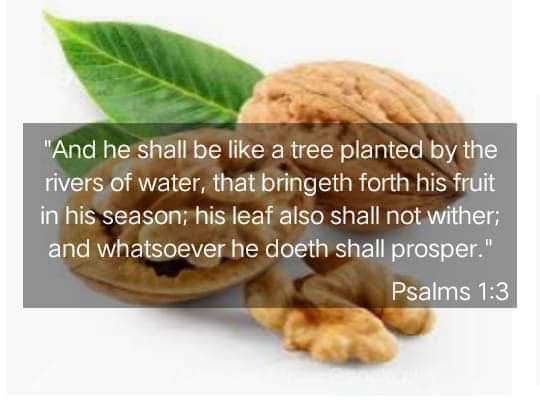
For our meditation this morning, let’s take lessons from walnuts.
June 26,
Walnuts
He shall be like a tree planted by the rivers of water, that brings forth its fruit in its season, whose leaf also shall not wither, and whatever he does shall prosper. Psalm 1:3, NKJV.
For a plant, the function of a flower is to attract and reward pollinators so it can get on with the job of making seed. Once the flower is pollinated, various parts of it develop into fruit, the place where the plant carefully forms seeds to begin with the next generation.
Identifying fruit types is bewildering complex to the point that only professional botanists can really know and appreciate the subtle differences between the drupe, a pome, a legume, a pepo, a nut, a hesperidium, a silique, etc. Then, when everything is nice and tidy, along comes a walnut. Botanists know that a walnut does not qualify as a nut, because it is more like a drupe. But it isn’t really a drupe, either. Some botanists call it a drupaceous nut. Others refers to it as a tryma (a nutlike drupe). A walnut must be God’s way of letting us know that He doesn’t use our definitions. He is not bound by our thinking or classification systems.
Gently crack a walnut open and, if you use great care, you can get the kernel out in one piece. It isn’t easy, because one delicate and easily broken connection joins the two halves. What a piece of architectural beauty a walnut is. If you can get it out in one piece, study the complicated curves and lobes of the kernel that look something like a miniature brain. How that got put into a very hard shell with no apparent connections to the shell or the outer husk is a marvel of packaging and engineering that we have yet to figure out.
But the real beauty is that chemistry in the walnut with high level of good cholesterol boosting omega-3 fatty acids, antioxidants, and minerals, walnuts are an excellent food. Study after study shows their cardiovascular and immunological health benefits. Besides that, walnut trees are beautiful ornamental shade trees that come in 21 different species. Juglans regia makes the best nuts and Juglans nigra the best wood, though its heavy musky nut is wonderful too. The wood from the black walnut trees is dark and hard with a tight grain. It is easy to tool and takes an amazing shine. Remember to thank God again and again for His awesome walnut creation.
Father, at times I am socially awkward. I don’t fit. Remind me that You shaped me for a special purpose. May I always honor You with my best.
–taken from God of Wonders devotional
–by David A. Steen, page 185
–photo credits to 123fr.com

 Connecting With Jesus
Leave a reply to williechii4u Cancel reply